
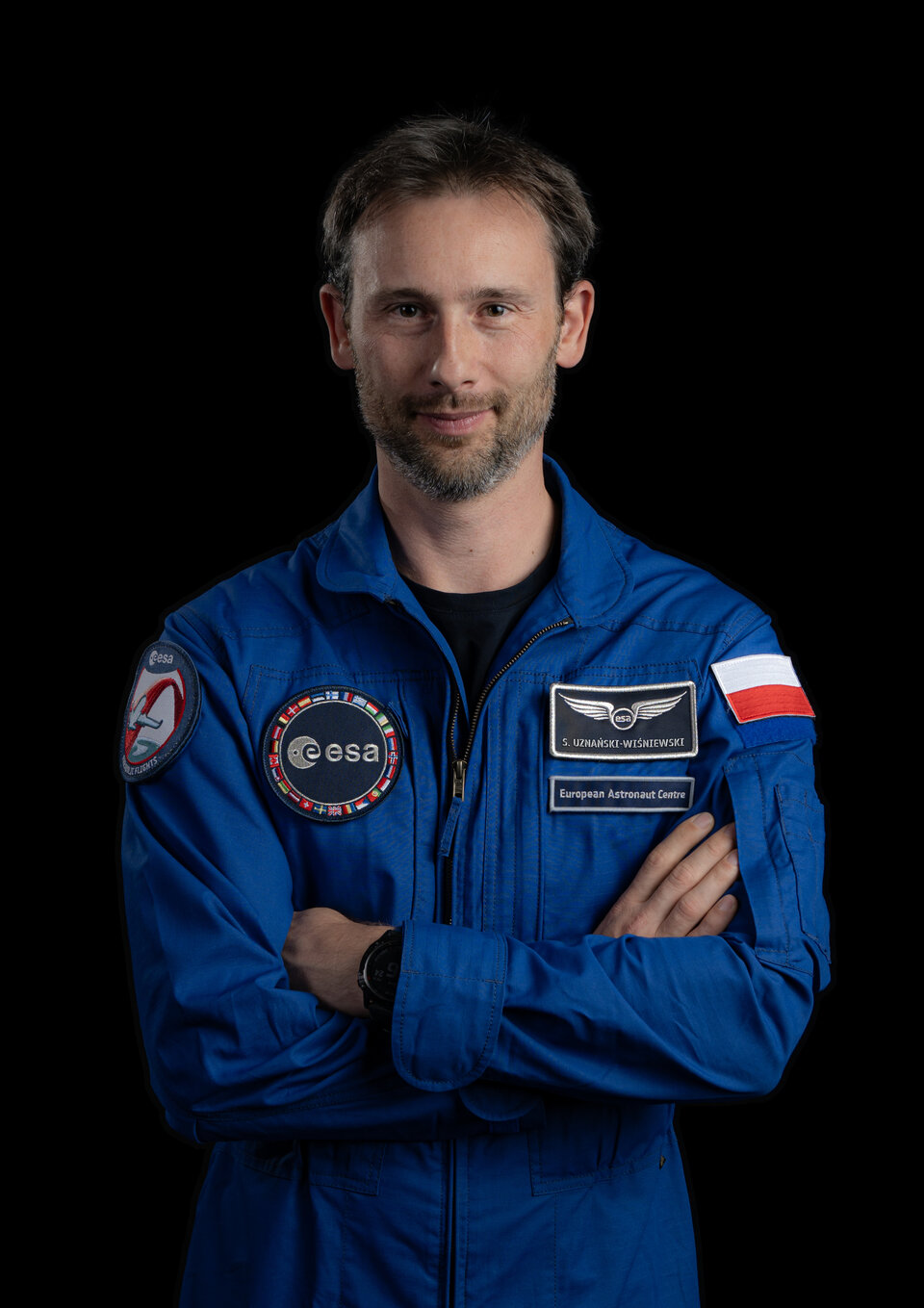
A year ago, on June 25, 2025, a Falcon 9 rocket climbed out of Kennedy Space Center in Florida and carried a Polish astronaut to the International Space Station for the very first time. The mission was called IGNIS, Latin for “fire”, and it lived up to the name.
Seven Times a Charm
Getting off the ground was not easy. The launch date moved six times before the crew finally made it to orbit. Weather was the first obstacle: strong winds in the flight corridor pushed back the early attempts. Then engineers found a liquid oxygen leak in the rocket’s first stage. After that, a separate leak appeared in the Russian Zvezda module on the ISS itself. Each time, the teams went back to the drawing board.
On the seventh attempt, it worked. At 8:31 in the morning, Polish time, the Falcon 9 cleared the launch tower and headed for orbit.
The crew flew as part of Axiom Space’s Ax-4 mission. Commander Peggy Whitson of the United States led the team, joined by Indian pilot Shubhanshu Shukla and Hungarian mission specialist Tibor Kapu. Poland’s representative was mission specialist Sławosz Uznański-Wiśniewski. What made the crew particularly striking was that Poland, India, and Hungary were all returning to human spaceflight simultaneously – each for the first time in over four decades.
The Man Behind the Mission
Uznański-Wiśniewski studied electronics and telecommunications at Łódź University of Technology. After graduating, he moved into space technology, and eventually joined CERN in Geneva, where he spent more than a decade building radiation-hardened electronic systems. In 2022, ESA chose him as a reserve astronaut from a field of 22,500 applicants. A year later, he received a flight assignment to Ax-4.
He was only the second Polish person to reach space, after Mirosław Hermaszewski in 1978, and the first to board the ISS. There is also a neat coincidence in his birthday: he was born on April 12, 1984, exactly 23 years after Yuri Gagarin’s first spaceflight.
Eighteen Days of Work
The Dragon capsule docked with the ISS on June 26, the day after launch. The crew spent 18 days on the station before undocking and splashing down on July 15, for a total of 20 days in space.
Uznański-Wiśniewski had a full schedule. He ran 13 scientific experiments, all developed by Polish universities, research institutes, and companies working with ESA. The range was broad:
- Immune Multiomics – looking at how microgravity affects the human immune system
- LeopardISS – putting an AI-capable processor through its paces for future satellite use
- PhotonGrav – testing a device that lets users control a computer using only brain signals
- AstroMentalHealth – tracking psychological wellbeing during long periods of isolation
- Wireless Acoustics – mapping noise levels on the ISS using a wireless sensor network
- Space Volcanic Algae – checking whether extremophile microalgae hold up in space conditions
- Human Gut Microbiota – recording how gut bacteria change during spaceflight
- Stability of Drugs – exploring which polymer materials best shield medicines from cosmic radiation
Alongside the research, he carried out 30 educational demonstrations and took part in four live video calls with schoolchildren gathered in Łódź, Wrocław, Rzeszów, and Warsaw. The Polish Space Agency confirmed that all primary mission objectives were fully met.
What He Took With Him
Uznański-Wiśniewski did not travel light on the symbolic front. He brought a patch from Hermaszewski’s original spacesuit, a fragment of a Chopin manuscript, three poems by Wisława Szymborska, and a map from Copernicus’s De revolutionibus. He also packed a lump of salt from the Wieliczka mine, a piece of Polish amber, and, perhaps most memorably, freeze-dried pierogi.
The mission patch told its own story. At its centre sat the Polish white eagle. Around it, the design wove in a flame, the outline of the Orla Perć ridge trail, the solar panels of the ISS, and the constellation of Scutum Sobiescianum, named after a Polish king.
Why It Matters
The IGNIS mission gave Polish research institutions something they had never had before: hands-on access to the ISS as a working laboratory. Some experiments simply cannot run on Earth – microgravity changes too much. By running 13 of them in a single mission, Polish science moved from the sidelines to the floor.
The industrial side matters too. Polish companies built hardware that flew in space and performed under real mission conditions. That is a different kind of credential from anything a ground test can provide.
The educational programme has lasting reach as well. POLSA is producing 60 teaching resources – lesson plans, videos, and classroom experiments – drawn directly from the mission. A workshop series called “Become a Space Engineer” is already running for secondary school students.
A Year On
IGNIS was not a one-off. It was an argument that Poland belongs in the conversation about the future of space science. The experiments Uznański-Wiśniewski ran may yet find applications in medicine, neurotechnology, satellite engineering and biotechnology.
Sources: Polish Ministry of Development and Technology, European Space Agency