
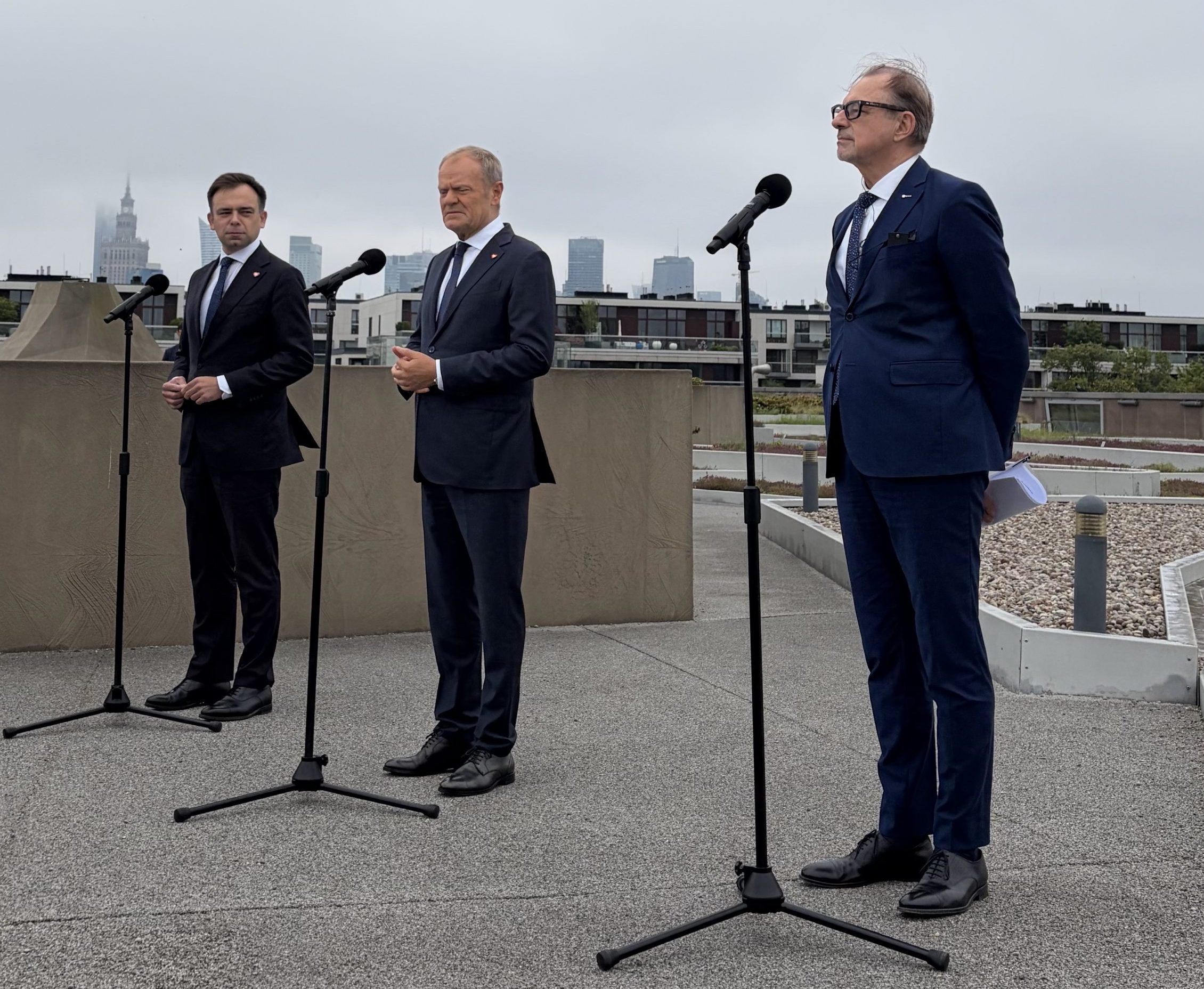
The announcement of the new ESA centre in Warsaw, 13 July 2026. Photo: ESA / Barend Leyts.
The ESA centre in Warsaw marks an important new chapter in Poland’s growing involvement in European space activities. Announced in July 2026, the planned European Space Agency facility will focus on civil security, resilience and advanced space technologies. But what will the centre actually do, and what could it mean for Polish researchers, engineers and the country’s space sector?
A new milestone for Poland’s space sector
Poland is taking another significant step in its involvement in European space activities. On 13 July 2026, the European Space Agency (ESA) and the Polish government officially announced that Warsaw had been selected as the location of a new ESA centre dedicated to civil security and resilience.
The announcement followed a letter of intent signed by ESA and Poland in November 2025, which initiated joint preparations for the establishment of the facility.
According to the Polish government, the Warsaw facility will be the first ESA centre of its kind located outside the territories of the Agency’s founding Member States.
The decision reflects Poland’s expanding involvement in European space programmes and its growing capabilities in research, engineering and space-related technologies.
What will the new ESA Centre in Warsaw do?
Although space exploration is often associated with astronauts, rockets and distant planets, satellite technologies also play an essential role in protecting infrastructure, monitoring environmental conditions and supporting emergency response on Earth.
The planned centre in Warsaw will focus primarily on civil security, resilience and the use of space technologies to address emerging challenges.
According to the Polish Ministry of Economic Development and Technology, its main areas of activity will include:
- Crisis management: developing technological solutions that support civil protection and responses to emergencies.
- In-orbit operations: conducting simulations of advanced space missions.
- Satellite service monitoring: analysing disruptions that could affect the functioning and reliability of satellite-based services.
The centre is also expected to develop expertise in dual-use technologies, which can have both civilian and military applications.
Rather than duplicating the work of existing ESA facilities, the Warsaw centre is intended to complement the Agency’s capabilities across Europe.
Why does space technology matter for security on Earth?
Modern societies increasingly depend on satellite-based systems.

Earth observation satellites provide information that can support disaster management, environmental monitoring and assessments of changing conditions on the ground. Satellite communications can also help maintain connectivity when terrestrial infrastructure is disrupted.
However, these systems face challenges ranging from technical failures to interference and other threats.
Improving their reliability and ensuring access to timely information have therefore become important priorities for European space programmes.
The planned Warsaw centre will contribute to ESA’s work in these areas, including efforts to strengthen Europe’s ability to respond to crises and protect essential services.
Its development is connected to ESA’s broader activities in security and resilience, including the European Resilience from Space initiative.
Warsaw as seen by the Copernicus Sentinel-2 satellite. Contains modified Copernicus Sentinel data (2020), processed by ESA.
Poland’s growing role in European space research
Poland joined the European Space Agency in 2012. Since then, its involvement in ESA programmes and its domestic space industry have expanded considerably.
Polish research institutions, engineers and technology companies participate in projects involving satellite systems, scientific instruments, Earth observation and other space-related applications.
The country’s commitment to European space activities has also increased financially.
At ESA’s Ministerial Council meeting in November 2025, Poland declared a contribution of approximately EUR 731 million for the 2026–2028 period, demonstrating its intention to strengthen participation in the Agency’s programmes.
The planned centre in Warsaw represents another stage in this process, creating an opportunity to connect Poland’s scientific and industrial expertise with wider European priorities.
New opportunities for researchers, engineers and students
Beyond its strategic objectives, the Warsaw centre could create new opportunities for Poland’s scientific and technological communities.
The Polish government expects the facility to encourage cooperation between universities, research institutions, businesses, public administration and international partners.
Such collaboration could support research and development projects in fields including satellite technologies, secure communications, data analysis and crisis-management systems.
According to the Polish government, the planned centre is expected to create new employment and professional development opportunities for graduates of Polish universities.
However, the precise scale of employment, research activities and future partnerships will depend on the centre’s implementation and development.
When will the ESA Centre in Warsaw open?
The project remains in its preparatory phase.
ESA and Poland have established a joint task force to define the centre’s objectives, scope and implementation framework.
According to ESA, preparations are under way to launch initial pre-operational activities from 2027, with the centre expected to develop gradually. No confirmed date for the start of full operations has been announced.
The Polish government has likewise indicated that the centre could begin operations in 2027.
This means that while the decision to locate the facility in Warsaw has been officially announced, its full operational capabilities are still being developed.
A new chapter for Polish science and technology
The establishment of an ESA centre in Warsaw is more than a symbolic recognition of Poland’s growing position in Europe’s space sector.
It represents an opportunity to strengthen international scientific cooperation, develop advanced technologies and contribute to solutions addressing challenges both in space and on Earth.
For Polish researchers, engineers and students, the project could open additional pathways into European research and innovation programmes.
For Europe, it is part of a broader effort to build more reliable, secure and resilient space-based infrastructure.
And for Poland, it marks another important step in a space journey that continues to gain momentum.
Sources
- European Space Agency (13 July 2026), ESA and Poland to establish a new civil security and resilience centre in Warsaw.
https://www.esa.int/About_Us/Corporate_news/ESA_and_Poland_to_establish_a_new_civil_security_and_resilience_centre_in_Warsaw - Ministry of Economic Development and Technology (13 July 2026), ESA Centre in Warsaw.
https://www.gov.pl/web/development-technology/esa-centre-in-warsaw - Polish Space Agency (14 July 2026), Ośrodek ESA powstanie w Warszawie. Konferencja „IGNIS – trajektorie przyszłości”.
https://polsa.gov.pl/wydarzenia/osrodek-esa-powstanie-w-warszawie-konferencja-ignis-trajektorie-przyszlosci/ - European Space Agency (27 November 2025), Poland and ESA discuss plans for new security centre.
https://www.esa.int/About_Us/Corporate_news/Poland_and_ESA_discuss_plans_for_new_security_centre